Thursday, November 3, 2011

Autumn in Bethesda

Just a few pix. Click to enlarge.

Credit all: C. G. Wagner

After a storm:

Setting sun on autumn leaves:

Morning illumination:

and the new public art installation at Union Hardware:


Friday, October 21, 2011

ReEntering Unreality


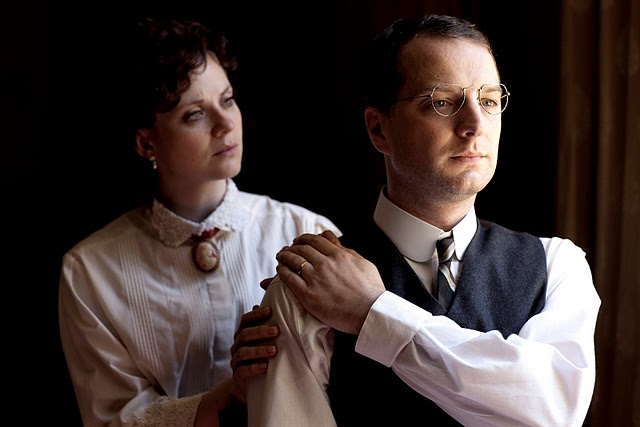
Back from Round House's production last night of ReEntry by Emily Ackerman and KJ Sanchez, a powerful piece on the trauma of returning "home" from war. And "home" is a tricky term; to a Marine, "home" is the Corps, whereas family and the complacency of people bitching about who's on Dancing with the Stars is the surreal unreality.

The staging of interwoven monologues is not my favorite dramaturgical choice (see also The Carpetbagger's Children, for instance). The characters--a mom, a sister, their two sons/brothers, a C.O., and others portrayed by the five actors--were built from interviews, so the reality was embedded. But the lack of interaction between the characters is a step away from the reality (or simulation of reality) in witnessing human relationships in real time. Add the actory voices, and it seems too unreal.

Even the chin-mikes to allow the actors to be heard by the audience without straining their voices was a check on reality to me. And because there's the phenomenon known in science--that the act of observing alters the experiment--I didn't get a sense of what the real reality would be for these characters after they stopped talking to the interviewers recording their stories.

Still, there was a lot to this very strong production. I could relate to the idea of children going to war when the C.O. talked about what he tells parents who are sending their children into this real danger just after they've graduated from high school. I thought of myself at 18 dealing with something like the wars in Iraq or Afghanistan. I wouldn't have had a clue what that reality would do to me.

[SPOILER ALERT]

And despite the lack of interaction between the characters, there was real poignance to the stories they told about each other. The sister, of course, I could relate to. She speaks at the end of how her brother told her to stay put in her apartment if "shit comes down" again like 9/11, and he would beat a path of destruction to her door to evac her. Any sister of any brother would want to hear just that, and probably has heard it more than she even can remember.

Cast:
Liz (sister)/Suzanne: Jessi Blue Gormezano
John (older son/brother)/Pete: Brandon Jones
Mom/Maria: Sameerah Luqmaan-Harris
C.O.: Larry Mitchell
Charlie (younger son/brother)/Tommy: Ben Rosenblatt

Directed by KJ Sanchez.
Plays at the Round House Theatre, Bethesda, Maryland, through October 30.

Sunday, October 16, 2011

Musical of Our Discontent


credit: Deen Van Meer, Kennedy Center


Back from Les Miz 2.0, the 25th anniversary full-scale re-thinking of the 1985 amazingness. I wasn't really sure I wanted to see this, since the 1985 KenCen pre-Broadway run was so indelible, but they promised this one would be good, and it certainly erased the memory of the tacky road-show version that carried on at the National a few years ago.

It is critical that I be induced to weep during the First Act Finale ("One Day More"), and the fact is, with this show, I began weeping when the priest brings Jean Valjean into his home--"have a seat, have some wine"--the first act of human kindness extended to the villainous bread thief Valjean after 19 years of captivity. This is even before the priest pays it forward by not turning him in to Javert for stealing the silver. Why didn't I bring tissues? Anyway, the cathartic requirement of theater was amply met.

I'm a little dim on French history, but I believe this takes place after the big Revolution. People are still jobless and desperate, discontented with the wealthy.

Which is pretty much where we are today. It's hard not to notice the similarities between Marius and his compatriots and the Occupiers of Wall Streets around the world just now. What they also have in common, in my mind, is the lack of a clear goal and strategy for achieving it. So far in the twenty-first-century version, at least the disobedience and protests have been largely civil.

Back to the show.... The other similarity I was struck by was to West Side Story (aka Romeo and Juliet), even so far as the staging of the lovers' first rendezvous o'er garden walls and under balconies. And of course the grand Act One Finale that weaves the threads of character and melodic themes into one magical tapestry of urgency, to get through the line at the restroom and back in your seat to see how it all turns out in Act Two.

Dissimilarities to the original production in 1985: Well, you don't have Colm Wilkinson, Frances Ruffelle, or Patti LuPone. The 2011 Valjean, J. Mark McVey, is an indomitable presence, but his delivery was more theatrical than Wilkinson's; that is, the lines were acted as much as sung. I'm trying to say this without judgment; different is just different. Wilkinson's voice had as much power as tenderness and created a purer characterization of Valjean.

The biggest dissimilarity among the actors was in Eponine, portrayed in the original by the heartbreakingly waifish Ruffelle and in the 2011 version by Chasten Harmon, far too sultry and womanly to be a waif (the character references Anybodys from West Side Story). She's more of a Spamalot Lady of the Lake, wondering what ever happened to her part.

The bottom line: I and my fellow standing-ovation-givers give the production an A. But I didn't get the cast recording. I have the cast recording.

A side note: the bio in the program for Cameron MacIntosh, the show's producer, made me smile. It reads, in its entirety:
Cameron MacIntosh (Producer) produces musicals.

Tuesday, October 4, 2011

Pattern Recognition

It took a while, but I finally came up with a theme for this blog. (See subtitle, above!)

Of course, it is ironic that I place myself in the role of "Audience" and yet blog publicly, as though anticipating an audience myself....

love, hosaa
somewhere around the second-to-last row of the balcony

Sunday, October 2, 2011

Social Injustice, The Musical!


The other day when I told my friends I was going to Ford's Theatre to see a musical about a Jewish man wrongly accused of assaulting a young girl, one among my fellow dinner companions laughed out loud.

"IIII didn't raaaape you,
Sweeeeet-hearrrrrt!"

(This, mind you, was on Rosh Hashanah. Oy.)

Musicals are supposed to be madcap romps, I guess, like anything with Mary Martin or Ethel Merman in it.

Or, you know, West Side Story or Cabaret. Both dealt with prejudice, as does Parade by Alfred Uhry (book), Jason Robert Brown (composer), and Harold Prince (co-conceiver) and directed by Stephen Rayne.

The fact-based story involves Atlanta pencil-factory supervisor Leo Frank (played by Euan Morton), a transplanted Brooklyn Jew, who becomes a scapegoat when 13-year-old factory worker Mary Phagan (Lauren Williams) is found murdered in the factory's basement.

In the course of the trial and its aftermath, Leo comes to understand and appreciate his Southern (and Jewish) wife Lucille (Jenny Fellner), steelier than any of the other Atlanta magnolias and equal to the challenge of forcing the governor (Stephen F. Schmidt) to reopen the case.

On a Sunday afternoon, the theater crowd is typically touristy, but in my little area there seemed to be a large number of theater afficianados and not just Lincoln buffs. I overheard a word or two before the show and during intermission referring to the Broadway version; others remarked on the accuracy of the events (I didn't quite catch what one person said Uhry supposedly admitted to changing, factually, for the drama).

I, on the other hand, went in pretty ignorant. That's why I couldn't tell my friends why they shouldn't laugh at my going to a musical about an assault case.

Anyway, just as the actors began the performance by casually wandering up the aisles from the back of the house and strolling into position on stage, at least one couple in the audience got up and not-so-casually fled just a few minutes before the end. What they were anticipating, I knew not, exactly. (The young theater-buff sitting next to me had been weeping for the last few scenes.)

The powerful image of an onstage lynching has to be one of the most chilling pieces of stagecraft I've ever seen. It is not one I will soon forget.

love, hosaa
chilled

ETA (Oct. 3): The ending that I described above isn't the end ending, which I missed because of my sight-line on the left side of the orchestra. At the end, Lucille wanders among her fellow Atlantans, not joining in their rousing chorus about how much they love being Southerners and all that. Her attitude is silent judgment.

But when she stands upstage center, I couldn't see her face at all. Did she join in the chorus or remain in silent judgment? Spoilers welcome, please!

Wednesday, September 21, 2011

Two Singers: Nnenna Freelon and Elliott Yamin

Two singers I catch around town as often as I can just happened to be in the neighborhood (or close enough) in the last couple of weeks: Jazz artist Nnenna Freelon and American Idol alum (season five) Elliott Yamin. They don't have terribly much in common, except I like them both for their unique voices. You don't mistake them for anyone else.

(And you know that's why I like Clay Aiken, too, but while he is working on his surprise for my birthday next month--which I am guessing is going to be his plan to collaborate with David Foster on adapting my screenplay into a Broadway musical--I have to spend this time pursuing my other interesting interests. Pardon my daydream...)

Both Nnenna and Elliott played to less than packed houses at the Strathmore and the Birchmere, respectively. This is unfortunate, but it didn't affect their performances.

Nnenna goes into her own world in her dreamy interpretations, bringing the audience along into the experience. "Skylark" gave me chills, performed with simple bass accompaniment.

One difference between a Nnenna/Strathmore experience and an Elliott/Birchmere one is my level of inhibition in clack-gathering. It's just taboo in a concert hall like Strathmore, and an artist of Nnenna's elegance, well, it would just seem like a violation to try to video her performance. At the Birch, with a guy like Elliott joshing with his E-Train riders in the audience, the pictures and videos are almost expected.

So to give you Nnenna's "Skylark," I borrow from someone else's lack of inhibition. This is from a year ago:


And "God Bless the Child," which made me feel as though I never heard or understood it before:


Now, Elliott, on the other hand, I had no problems mustering courage to video, so these are mine. My only problem was the tall fellow directly in my line of sight. (Situation normal.)

Here he is previewing some new songs, and delivering a heartfelt version of an earlier hit.


Love, hosaa
hearing (really great) voices

Thursday, September 8, 2011

Fahrenheit 21C

Back from Round House Theater's production of Ray Bradbury's futuristic classic, Fahrenheit 451, with special multimedia effects that really do make that future feel now.

The credit for that stunning stagecraft, as well as the directing (Sharon Ott) and two of the principal actors--David Bonham ("Montag") and Aurora Heimbach ("Clarisse")--goes to the Savannah College of Art and Design.


The story is well known enough: Firemen burn books because books contain ideas, which just confuse and upset people. In a culture that fears dissent, ideas are weapons of mass destruction. (H. G. Wells also foresaw a book- and thought-free future in The Time Machine.)

What makes this production so contemporary is not just the cool multimedia elements, but also its reflection of our relationship to multimedia itself. Look around at how many people are connected to their devices, hooked on media walls that aren't just on the walls anymore--they never leave our hands. And yes, in many ways, this does detract from our ability to focus, reflect, think, and question.

But for me the real foresight of Bradbury comes through in Montag and Clarisse's escape to the woods and in the preservation of books through oral storytelling.

Futurist William Crossman has long been forecasting the rise of voice-based computing and the lessening need for text. See VIVO [Voice In/Voice Out]: The Coming Age of Talking Computers.

Frankly, as much as I love Moby Dick, I can't imagine memorizing it. Nor do I necessarily buy into the idea of rote memorization as valuable for critical thinking. But Bradbury's point about conveying cultural knowledge through the medium of storytelling is valid, and Crossman's point about advanced societies relying less on text to do the conveying is becoming increasingly validated.

Bradbury's prescription for his hero, escaping to nature and away from the oppressively conforming and soul numbing city, is the same prescription we hear today from Richard Louv, author of Last Child in the Woods and The Nature Principle. Louv writes about his prescription for children hooked on technologies and suffering from nature-deficit order in the next issue of THE FUTURIST.