Thursday, May 28, 2015

A Tale of Two Plays

Slightly behind in my recapping enables me to bring two current productions together: A Tale of Two Cities performed at Synetic Theater and NSFW performed at Round House Theatre.


Coincidentally, the term NSFW was just added to Merriam-Webster's dictionary, which defines it as "not safe for work" (meaning, if you're e-mailed a link or attachment so labeled, don't open it at the office).

In the RHT production, the term is expanded to "not safe for women," meaning workplaces such as playwright Lucy Kirkwood's two fictional commercial magazine offices, Doghouse and Electra, that sexualize, objectify, exploit, and manipulate images of women. While I could relate a bit to the young woman working at Doghouse (she needs the work), there are compromises and comeuppances in this story that I just don't get. (Thank goodness for noncommercial journalism, right?)

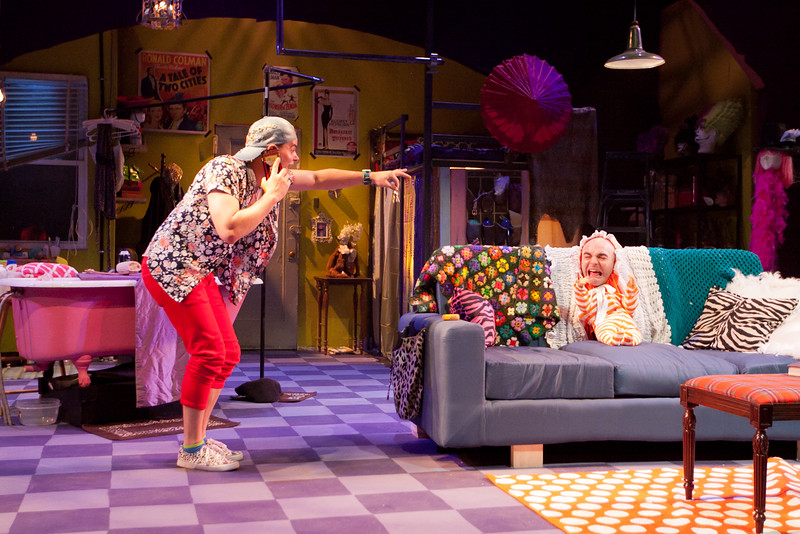
In a way, exploitation and objectification of female imagery is also what the drag queen Jerry (Alex Mills) does at Synetic's Tale, in an adaptation originated by Everett Quinton. Jerry entertains an irrationally inserted baby in his apartment (Vato Tsikurishvili as Dorian the baby) as he prepares to perform his act.

Alex Mills (Jerry) and Vato Tsikurishvili (Dorian), A Tale of Two Cities. Synetic Theater

The parallels between Jerry's primping for his act and Electra editor Miranda's (Deborah Hazlett) primping for a night out were astonishing. (No production photos for NSFW up yet, but if you see both shows, you'll see what I mean.)

Alex Mills, A Tale of Two Cities, Synetic Theater

Alex Mills, A Tale of Two Cities, Synetic Theater

The lesson is clear to me: 'Tis a far, far better self-actualization when you take control over your own life, work, image, sexuality, and self-expression.

Love, hosaa
safe for work

A Tale of Two Cities
Synetic Theater (1800 South Bell Street, Crystal City, VA 22202)
May 13 through June 21, 2015

NSFW
Round House Theatre (4545 East-West Highway, Bethesda, MD 20814)
May 27 through June 21, 2015

Sunday, May 10, 2015

The Mahler Ballet

As promised, here is the result of my scribbling the other day while listening to the working rehearsal of Mahler's Fifth Symphony.


The Officer's Bride

Place: A seaside market town.
Time: About when they usually place stories like this, vaguely 19th century.

I
A rising storm bodes ill. War is imminent. The villagers are aware their young men will be called away, but their fears are abstract and distant. Life goes on, markets are busy, and there's a big wedding to prepare for: the mayor's daughter, Barbara, and her betrothed, the handsome officer Gregor.

As the young men march into the square in their identical uniforms, Barbara laughingly pretends not to recognize any of them, though they are all her childhood friends and the sweethearts of her bridesmaids. Barbara tells all her friends to give their sweethearts a handkerchief in his favorite color--a token to remind him he is unique and loved. Barbara gives Gregor a crimson handkerchief, which he kisses and tucks into his coat.

The call to war is heard, alarming the mothers of all the young, inexperienced soldiers. The fathers try to assure their wives and advise their sons.

II
A month later, a witness arrives to describe the battle. As mothers mourn and fathers put on a brave front, the Mayor (Barbara's father) questions the witness further. They learn that it was not their sons who fought in this particular battle, but their turn may soon come.

III
Barbara attempts to keep her friends' spirit up by making them continue preparing for the wedding. She tells them how she and Gregor met and fell in love. And she asks her friends each in turn, Was it not this way for you? Her friends dance while waving their brightly colored scarves, which match the colored kerchiefs they gave their sweethearts, 

IV
Months pass; the war is over, and the men are to return. They were victorious in their battle, but the villagers are aware many will not return. The wedding preparations have turned into a welcome home, but it is tinged with dread.

One by one, the uniformed soldiers return, each greeted by his sweetheart all dressed in his special color. the square is filled with a joyous, multicolored bouquet of humanity.

V
As the square clears, Barbara is alone, in her bridal white, but with a black mourning scarf over her shoulders. Her Gregor has not returned. The villagers, in mourning black, attempt to revive her spirits. She dances with all her friends' sweethearts, but she reunites them each with their true loves, telling them all to be happy. This is the life that her Gregor fought and died to secure for them.

Barbara's father drapes his mayoral sash over her shoulders, declaring her his logical successor to lead the village. As the men of the village lift her on their shoulders, she lifts her mourning scarf over her head. She flips it over and holds the crimson side upwards, showing it to Gregor in heaven.

Friday, May 8, 2015

My, My, Mahler

I'm already late in my recap of yesterday's working rehearsal for the NSO performance last night of Mahler's Fifth Symphony at the Kennedy Center, so the Washington Post's review, focusing on guest violinist Leonidas Kavakos's participation, should fill in my usual gaps.

What I love about the working rehearsals is seeing the actual work go into an artistic performance. The musicians are not demigods, delighting the elites among us mere mortals (though you do have to be elite enough to join the Kennedy Center's second-to-lowest membership level to score a rehearsal invite--a privilege I have to forgo for the next season due to my recently compromised budget). The disadvantage is that you don't get the whole impact of the performance, as there are fits and starts, do-overs, and, as I learned, movements might get moved out of order.

Yesterday's experience was a delight on at least two levels for me, so there will be a part two of this post coming later (I know not to say "Soon" in some of my social circles).

The Level One delight (for blog post Two) was hearing Mahler's Fifth Symphony and being caught up in a vivid and very visual narrative. Some call that daydreaming; others call it plot development. The result was a treatment, a story line, for a ballet. There was enough light in the Concert Hall's orchestra seats to let me scribble notes throughout the rehearsal, which apparently broke for an intermission before completing all five movements.

I know this because, ignorant as I am about music, I never demur from asking stupid audience questions when given the opportunity. And I got that opportunity, so this gave me a bonus delight from yesterday's experience. A woman sitting in the row in front of me appeared very knowledgeable about what was going on, and I overheard her tell her seatmate that the conductor left something out. There was something wrong about the movements and the order in which they were rehearsed.

And this expert in the audience also happened to notice me scribbling in my Handy Dandy Notebook. She assumed I had some musical knowledge and would be able to answer her question about the missing Mahler movement. I oh-so-casually said, No, I never heard this piece before. I'm just writing a ballet here. Heh.

We had a lovely conversation after that. My new friend, a violinist, was happy to hear how I, as an audience member, responded to the music. (I won't lie, I don't know how proficient any particular musician is except how he or she makes me feel; that Mahler piece, despite all the interruptions, had me in tears.)

So at the end of the working rehearsal, I got to ask my Stupid Audience Question, something that had been niggling at me since last year's NSO working rehearsal with clarinetist Martin Fröst and guest conductor Osmo Vänskä, performing a clarinet concerto by Finnish composer Kalevi Aho. I noticed that the musicians were very busy scribbling notes on their sheet music so as to execute Vänskä's instructions on the obviously difficult piece. So my question was, Do the musicians get to keep the sheet music?

The answer, my friend informed me, is No. The sheet music used by the NSO is returned to the orchestra's library, where someone erases all the pencil marks scribbled by the musicians. Mystery solved! I love it.

Next time - Notes on a Ballet inspired by Mahler's Fifth Symphony.

Love, hosaa
dancing in my mind

Thursday, April 9, 2015

Living, Working, Resting with Vanya

I'm behind, but before I get more behind, a quick mention of Round House Theater's opening of Uncle Vanya.

promotion art for Round House Theatre, via Facebook

The best thing about Chekhov is the talent he attracts, and the talent on RHT's stage last night was virtually a who's who of Washington theater (alphabetically): Gabriela Fernandez-Coffey, Kimberly Gilbert, Mitchell Hébert, Mark Jaster, Nancy Robinette, Ryan Rilette, Eric Shimelonis, Jerry Whiddon, and Joy Zinoman.

The production was beautifully laid out, with characters entering and exiting from normally underutilized voms, and the language was updated accessibly by Pulitzer Prize winning playwright Annie Baker.

Pre-performance discussion at Round House Theatre, via Facebook.

But even all this talent couldn't keep me from nodding off in Act One. It's not their fault, and it's probably not even Chekhov's fault, though he is probably one of my least favorite Russian writers (below Gogol, ahead of Pasternak). As it so happens, this week I rejoined the working Vanyas, Sophias, and Marinas of the world, and rest will have to wait.

That's sort of the gist of the story: We all work, sort of, and we all live, sort of. Some of us "work" a little uselessly, like the professor (Alexander, Jerry Widdon) who basically writes about what others have thought and written about, but who ranks above the brother-in-law (Vanya, Mitchell Hébert) who manages the estate that provides income for the family.

As for the women, we can be beautiful and desired but ultimately bored and useless (Yelena, Gabriela Fernandez-Coffey), or we can love passionately but futilely, plain and ultimately accepting (Sophia, Kimberly Gilbert). The only two characters who seem to go about finding their own way to happiness are the doctor and forest-saver (Astrov, Ryan Rilette) and the nanny (Marina, Nancy Robinette). They both live useful working lives that seem to fulfill them.

I guess that's as much as I can ask for out of life: a useful and fulfilling one. Funny to feel like a "minor character" in a play (Yelena's complaint). At least you're in the play.

love, hosaa
from somewhere in row D

Saturday, March 7, 2015

Psycho Spoiler

Okay, I know it's a 55-year-old classic and everyone's seen it, but why in the world would Comcast/Xfinity give away key details in its plot description for Psycho?


Here is how it describes the movie (spoiler alert):

A psychotic motel owner obsesses over his late mother while becoming the prime suspect in a murder case involving one of his recent guests--a pretty secretary who checked into the motel and never checked out. An undisputed horror masterpiece.

Never mind the run-on sentence. We're not supposed to know the mother is dead until the end of Act II, or that the motel owner is psychotic until the climax of the film. Arghh!

Here's my rewrite:

Lonely motel owner obsessively protective of his mother has fateful encounter with a pretty secretary on the lam after stealing money from her boss to be with her boyfriend.

Or:

Pretty secretary impulsively steals $40,000 from her boss to be with her boyfriend. While on the lam, she has a fateful encounter with a lonely motel owner who's obsessively protective of his sick mother.

Or:

When a pretty secretary disappears after stealing money from her boss, her sister and boyfriend trace her to a motel owned by a lonely mama's boy. 
Seriously, Xfinity, or whoever writes your program descriptions. Do better.

Love, hosaa
Shocked and appalled.


Monday, February 16, 2015

Much Ado about No Shakespeare

Back from yesterday's matinee performance of Much Ado About Nothing at Synetic Theater in Crystal City. This was the 11th of Synetic's renowned wordless (not silent) Shakespeare productions, an oxymoron that produces varied reactions (not unlike those when revealing that one is a Clay Aiken fan), ranging from bemused condescension to moral outrage.

Ben Cunis as Benedick and Irina Tsikurishvili as Beatrice. Program art for Much Ado About Nothing, Synetic Theater.

Shakespeare, of course, offered the world more than poetry, and the gift of the Synetic approach is that it winkles out the subtleties of character development and the nuances of situation comedy--and tragedy--that is also all Shakespeare. A wordless theatrical production of Shakespeare is every bit as legitimate as the Prokofiev Romeo and Juliet or the Mendelssohn Midsummer Night's Dream, and music and dance are among my favorite tools in the artistic toy box.

It's interesting that a lot of the updates of spoken Ado are set in the black-white-silvery worlds of Art Deco, leaving all color to the language, whereas the text-free Synetic production is all color and movement and music. Set in Fifties-era Las Vegas, with showgirls and motorcycle gangs (wearing "Syneticon" gang leather jackets), this Ado drives a harsher wedge between light and dark, farce and ferocity, through sheer physical power--not just the athleticism of the dance and pantomime, but also the attention given to details in props, costumes, lights, and music. All senses are on alert and fully, energetically engaged.

There is, appropriately, a parental advisory on this production, which goes a bit beyond the bard's usual bawdy humor: "This production is recommended for ages 14+ for some drug use and stylized sexual content." It's not for those squeamish about hypodermic needles, either.

Much Ado About Nothing by William Shakespeare
Synetic Theater (1800 South Bell Street, Crystal City, Virginia 22202), through March 22, 2015
Directed by Paata Tsikurishvili, choreographed by Irina Tsikurishvili


Thursday, January 29, 2015

Blistered, Burned, Enraptured

Back from last night's first preview performance of Gina Gionfriddo's Rapture, Blister, Burn, at the Round House Theatre, and the only glitch in the proceedings was that they brought the houselights up when the audience was trying to give the cast a standing ovation. I felt a little cheated out of showing them the love.


Previously in Hosaa's Blog, I reported very little about my experience with Gionfriddo's last play on the RHT stage, Becky Shaw. Didn't like it. The characters were just not people I wanted to spend two hours of my life with. With RBB, however, I had more in common with the characters: two 40-something women--one married and the other a single, successful academic--and the lunk of a husband/love interest they shared, plus the 70-something mother of the single scholar, and one wiseass 20-something babysitter/would-be reality-TV developer.

Oh, exactly which character did I "relate" to? "Cathy" (Michelle Six), the single, successful academic, you say? Ha Ha Ha! Well, actually, the part about her that I did relate to was her relationship with her mother, "Alice" (Helen Hedman), and the realization that no man would ever love her the same way that her mom did. That part is true, and a lot of us just don't realize that until mom dies. That's a shame.

I could actually connect a bit with the lunk of a husband/love interest, "Don" (Tim Getman), because at the root of his problems is his own self-defeating awareness that he can't live up to other people's expectations of him or to his own sense of potential. He resorts to pot and porn to soothe his sagging ego and goes on letting down the two women who (inexplicably, IMO) love and compete for him. (I guess I know what I resort to--not pot and porn, though. *g*) 

The stay-at-home wife, "Gwen" (Beth Hylton), is the judgey recovering alcoholic who yearns for the presumably better life of the single friend whose boyfriend she stole and married rather than completing grad school.

And for a generational perspective to balance that of the not-dead-yet heart-attack-surviving mom, we get the babysitter "Avery" (Maggie Erwin, my new great actress to watch). The wise-beyond-her-years free spirit is appreciative of the freedoms won by our feminist ancestors but can't really relate to the problems of an earlier era. We can vote because suffrage was obviously right. Duh.

Maggie Erwin. Publicity photo via RHT Facebook.
The characters are not quite caricatures, but do come off as stereotypes. Or maybe archetypes. And the business of women yearning to switch lives with each other is nothing new (see Turning Point with Shirley MacLaine and Anne Bancroft, for example). Then there's the ridiculous plot device of having the wife and babysitter as the only students of the single-scholar for a seminar on feminism and female portrayals in popular culture--a seminar that takes place in the mom's house so we can get all the females in the same place together, relating their personal experiences to academic observations.

But the direction by Shirley Serotsky and acting by all (seriously, Erwin is a revelation) more than made up for these contrivances. The historic and cultural references (Betty Friedan and Phyllis Schlafly, the messages behind slasher movies) all brought out touchstones to touch and mull on. And instead of just being angry and making the audience angry (or defensive), the dialogue, the conversations, invited a lot of self-reflection. What do we want as women? And what happens if we get it? Or don't get it? And what do men have to do with it anyway?

I go back to the relationship between the mother and the grown daughter. My mother was just that supportive and nurturing (in her own weird, narcissistic way--that's another blog). Mothers teach their daughters that love means being supportive and encouraging, so we expect that in a husband. When the men turn out to expect that of their wives but not of themselves, that's where the frustrations start.

Avery is the one with the answer to all that crap. Maybe you just outsource it.

love, hosaa
Still thinking a butler would be better than a husband, in many ways.