Wednesday, December 31, 2025

Books in review: A 2025 reading list

Expect my usual menu of Shakespeare, Dickens, and Austen (in celebration of Jane’s 250th birth anniversary this year). However, I thoroughly benefited by including a more diverse array of authors, again mixing fiction, nonfiction, poetry, drama, and what-not. (Was there any what-not? I think there was.) The list is largely chronological (by when I read them, not when they were written. Just to be clear).

  1. James, Percival Everett (fiction). One of the best books I’ve ever read (a phrase I’m going to repeat ahead), for its perception, its inspiration, its truth. And I loved Huck Finn, which I will probably never re-read without r-reading James.
  2. The Backyard Bird Chronicles, Amy Tan (nature, art). A favorite storyteller expands her subject and her art. This was an Audubon magazine recommendation, and it’s a treasure.
  3. The Bluest Eye, Toni Morrison (fiction). Another one of the best books I’ve ever read, and I can’t believe I’ve never read it before (a phrase I’m going to repeat ahead). I think back to being a little white girl, not especially privileged but certainly more so than Toni’s youngsters. I would hope I behaved better, but my hometown was what it was at that time.
  4. Fierce Poise: Helen Frankenthaler and 1950s New York, Alexander Nemerov (biography, history, art). Helen is one of the artists introduced in Ninth Street Women by Mary Gabriel and is now one I always look for in my museum visits.

  5. Fail-Safe, Eugene Harvey and Burdick Wheeler (fiction). A character-by-character approach into telling the story. It didn’t really work for me, but I guess that’s because I liked the movie better. Dr. Strangelove, that is.
  6. Lincoln and the Indians, David A. Nichols (history, Civil War era). Historians don’t set out to villainize, but clearly there were a lot of bad guys running Indian affairs for the U.S. Nichols does seem to excuse Lincoln from full culpability, what with his country-saving war and his country-expanding railroad and all.
  7. The Adventures of Curious George, Margret and H.A. Rey (children’s literature). It’s been on my “children’s” shelf a long time. The illustrations are a delight!
  8. The Constitution of the United States and The Declaration of Independence (documents). A good time to catch up, I think.

  9. Einstein: Decoding the Universe, Françoise Balibar (biography, science). You can’t write about Einstein without mentioning the science, but there’s a lot of social history in this (badly designed) little bio.
  10. Fathers and Sons, Ivan Turgenev (fiction). One of my top four Russian novelists, telling a compelling story with some of the social turmoil of the time.
  11. Ghetto Diary, Janusz Korczak (memoir). He saved children and went mad.
  12. The Remains of the Day (re-read), Kazuo Ishiguro (fiction). The butler didn’t do it.
  13. The Guns of August, Barbara Tuchman (history, World War I). A piece of history I’m not very familiar with. An archduke is shot and all hell breaks loose. The historian does not set out to establish villainy, but there are some pretty despicable dudes in this.
  14. Winnie-the Pooh, A.A. Milne (children’s literature). Another one of those books I can’t believe I’ve never read. And the illustrations are delightful.
  15. Man Ray (no author cited), Ediciones Polígrafa (biography, art). Man Ray (is that what friends called him? Or just “Man”? Or “Emmanuel”?) is one of my favorite artists, even when he was not doing Dada. I just think I get more out of art books looking at them than reading them.

  16. Jane Austen: The World of Her Novels, Dierdre LeFaye (history, sociology). A good overview of the novels’ setting in Regency England. I just think I get more out of Jane Austen reading her than reading about her.
  17. The Watsons, Jane Austen (fiction). I honestly don’t remember reading this.
  18. Minor Works (selections), Jane Austen (fiction). The “juvenilia” included Jane’s brief history of English monarchs. She seemed to have no love for Queen Elizabeth I, sharpening her satirical sword on her head!
  19. Invisible Man, Ralph Ellison (fiction). One of the best books I’ve ever read, and I can’t believe I’ve never read it before. I was almost halfway through the story before I realized the narrator was nameless.
  20. Notes from Underground, Fyodor Dostoevsky (fiction). Apparently one of Ellison’s inspirations. As much as I’ve always loved Dostoevsky, I liked Ellison’s story better.
  21. Charlotte’s Web, E.B. White (children’s literature). Another one I’d never read before. Life and death in a tale gentle enough for children to understand the realities of both.
  22. King John (re-read) William Shakespeare (play). Read in preparation for seeing a performance. I still cry when little Arthur dies.
  23. Wild Gratitude, Edward Hirsch (poetry). A fellow Grinnellian’s biography came out this year, but I thought I’d better read his poetry first. Lots of misty, rainy nights prompting reflections of life and love. 


  24. What Jane Austen Ate & Charles Dickens Knew, Daniel Pool (social history, reference). Explanations of much that might baffle you while reading 19th century English novels (not just Austen and Dickens). Keep as a useful reference. (I always thought a “bob” was the same as a pound. No, it’s a shilling.)
  25. Northanger Abbey (re-read), Jane Austen (fiction). Much funnier than I remembered! It would be hard to displace Pride and Prejudice from the top spot, but I now almost have a five-way tie for second place.
  26. Bordering on Madness, Andrew Popper (fiction). I left this on my shelf too long thinking it was some of Andy’s legal writing. It’s actually a ripping-good novel with criminal types and types with criminal tendencies. And a lovely love story.
  27. America’s Future: Poetry & Prose in Response to Tomorrow, Caroline Bock and Jona Colson, editors (anthology). It’s not futurism, except it includes my own essay, “Remembrance of Futures Past.”
  28. The Rubaiyat of Omar Khayyam [partial], Edward FitzGerald, translator (poetry). Just dipping into my ancient edition of Norton’s Anthology.
  29. Mrs. Dalloway, Virginia Woolf (fiction). Another “I can’t believe I never read this before.” A day in the lives of Mrs. D and people in or around her circle. Why does this stream of consciousness work for me when I can’t get a page into Joyce or Proust? I guess I want to live in someone’s house or neighborhood and not entirely in their head.
  30. 1984 (re-read), George Orwell (fiction?). It wasn’t a prediction. It was a warning. Then it became a playbook. 

  31. Killers of the Flower Moon, David Grann (history, 20th century Oklahoma). As we learned from Truman Capote, good journalism tells a cracking good story, and brings history to life better than most textbooks.
  32. The Cider House Rules, John Irving (fiction). Like A Prayer for Owen Meany, this Irving book sat on my shelf for too many years. One of the best stories one could possibly read about abortion, and why many people consider its re-illegalization a crime against humanity.
  33. Rosenkrantz and Guildenstern Are Dead, Tom Stoppard (play). Very absurdist in a Becketty way.
  34. The Cricket On the Hearth, Charles Dickens (fiction). I couldn’t figure out why this is known as a Christmas story, except that it’s sort of fairy-tale-ish, life-affirming, and written for the public at Christmas time like the Carol. Anyway, it was free from the Gutenberg Project and I could read it in a day.
  35. The Obama Portraits (no author cited), National Portrait Gallery (art and artists, the works of Kehinde Wiley and Amy Sherald). Captures a moment in time and what led to it. No such presidential portrait unveilings have succeeded these. And I don’t even want to look in that gallery right now (let alone the one in the White House).
  36. Reflections of a Futurist, Bob Chernow (futurism). Duty reading to remember my former professional life. This English major did learn a lot from working with authors at The Futurist magazine.

In addition to the aforementioned essay I contributed to America’s Future, I got far enough in my DIY piano lessons (Great Courses edition) to write my own little 45-second waltz, Hosaa’s Magnolias: Waltz in C. I wouldn’t subject any readers to a recording of my own playing, but I did create a piece of sheet music by hand. I hope it’s playable.


Love, hosaa
wondering what to read or write next

Thursday, November 13, 2025

I dreamed I was running

I dreamed that I was running. It felt good,

uphill a little on a path around the wood.

My legs were strong, my heart didn’t beat the way

a watch counts out the nervous pulse of day.


Where was I going? Or who running from?

Was I running alone in a Hopperscape,

warm, not hot, easing to a teasing horizon,

or fleeing shadows of lurking threats?


The vision, the feeling, evaporate.


I dreamed that I was running, terrified.

Our shelter had been shattered that night,

explosions and predators and treachery,

and only splintered walls and rusting beams to hide us.


Who was attacking? Or who protecting

from missiles and experimental aircraft

raining innovative destruction through azure air?


The vision, the feeling, evaporate

except the fleeting memory of running.


Cynthia G. Wagner, May 2, 2022

Tuesday, June 17, 2025

Edward, Silver-Lining It

The long- and well-remembered Edward Duke would have been 72 today, and happy heavenly birthday, dear one.

This date is always marked on my wall calendar (yes, wall calendar), along with a couple of other related anniversaries. (I don't take wedding anniversaries, Valentine's Day, Mother's Day, or other commonly claimed self-celebrations, so I'll commemorate my own ridiculous fondness for a goofy twit.)

As it happens, I also received today the summer edition of the quarterly Plum Lines journal of The Wodehouse Society, in which I've previously made a few remarks related to Edward. The administrators of said organization remind me my membership has expired and I owe them money. The thing is, they don't want money in the format I have previously used, a check (or cheque). They want something in the way of a digital payment. 

As my checks (or cheques) are no longer legal tender, it reminds me of how much has changed since Edward tap-danced off this planet in 1994. Computers were just becoming personal and had yet to reach their current status as the means of all communications, commercial, personal, comical, or devious.

Which leads me to the question, how in the world did I find an address for sending my fan letters to Edward? Without an Internet, we had to rely on available reference librarians, industry directories, professional connections included in printed programs saved from theaters. 

Somehow, I figured out that Edward must have belonged to some professional union, such as Screen Actors Guild. (Did I know then that he'd appeared in a few movies already, such as The French Lieutenant's Woman and Invitation to the Wedding? I don't remember. }

I did at last reach some organization and asked in my most professional-sounding big-girl voice to be connected with the membership department. Once connected, I suggested there was some slight urgency for my need to obtain a mailing address for one of their members. The individual receiving my request obliged very politely, perhaps even asking if there were anything else she could do for me. As there was not, I thanked her. 

I should note that this trick did not work ever again, but I had an address, even if I misheard the information and wrote to the wrong street in London. I didn't learn this until at least a year later when I received my treasured autographed publicity photo of Edward in his Jeeves and Wooster costumes.

My memories of Jeeves Takes Charge are dimming, though I saw Edward perform it at least four times. My pictures  (Yes, pictures) of him are on the bookshelf (Yes, bookshelf) next to the piano (digital keyboard) I am attempting to learn to play, and he watches over me, perhaps encouraging me. And I remember his awful Act III tap dance whilst singing "Look For the Silver Lining."

And I do.

Love, hosaa
silver-lininging

Edward Duke, Jeeves Takes Charge. Photo by Martha Swope
(Billy Rose Theatre Division,
New York Public Library Digital Collections, 1983)


Tuesday, March 18, 2025

Heaven Waited: March 20, 2025

Heaven has been waiting for Joe Pendleton since 1978. He wasn’t supposed to arrive until “10:17 a.m. on March the 20th of the year Two Thousand and Twenty-Five.”

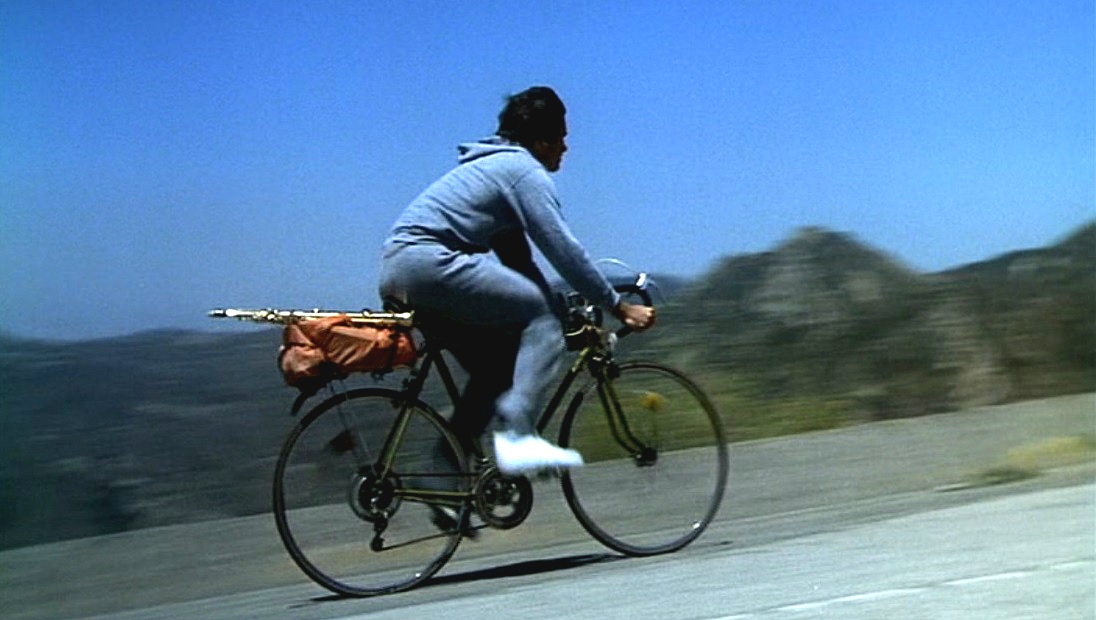
That was what was written, and Joe would have been happy to abide by what was written. But there was a little mix-up right when Joe was back in the pink—er, had just gotten his body back in shape. The young quarterback (well, in any other profession he would have been young) was set to start for the Los Angeles Rams in a few days, but there was an accident as he rode his bike into a tunnel on an otherwise quiet highway.

Joe Pendleton (Warren Beatty). Disaster ahead?

Except, as an athlete, he had fantastic reflexes and would have missed the car careering toward him. Probably. But his heavenly escort did not wait for the outcome, bringing Joe Pendleton to the Way Station nearly fifty years before his time.

Mr. Jordan himself verified Joe’s expected due date as March 20, 2025. It was written.


"Im not supposed to be here! You guys made a mistake!"

"Joseph Pendleton, due to arrive 10:17 a.m., March the 20th, the year 2025."

This is what was written by Elaine May and Warren Beatty in their 1978 screen adaptation of a play by Harry Segall, Heaven Can Wait. (An earlier screen adaptation was called Here Comes Mr. Jordan.)

To remedy Joe’s (Warren Beatty) loss of several decades of winning Super Bowls and falling in love, and so forth, Mr. Jordan (James Mason) scouted an available body for spirit Joe to Quantum Leap into. The requirement was that the death of this neomort would not yet have been discovered, so Joe could simply assume his identity. He was to carry on as that person, rather than as himself. But Joe couldn’t help being himself, could he?


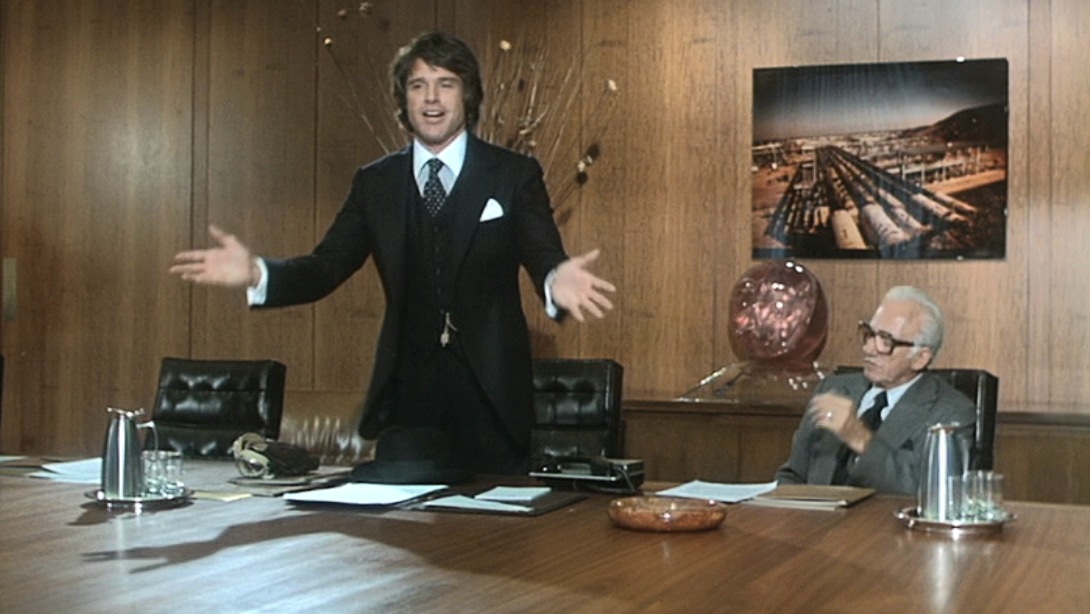
Spirit Joe would have turned Farnsworth into a philanthropist

First up was the unscrupulous industrialist Leo Farnsworth, murdered by his wife and private secretary (Dyan Cannon and Charles Grodin). Joe transformed this not-yet-dead Leo into a naive but fair-minded (scrupulous) industrialist. And of course he fell in love with the first beautiful environmental activist he met (Julie Christie). She saw something in his eyes. (Remember that.)


"I'm not really Leo Farnsworth! My name is Joe."

Whatever had been the rich bastard’s destiny in life ended with his interrupted murder, and we can assume the real Leo Farnsworth abided by what was written for him, whether his final destination was Heaven or Hell. No matter. Joe needed to get Leo’s body in shape in order to pursue his own destiny—playing in the Super Bowl.

To help him, Joe called on the Rams’ trainer, his good buddy Max Corkle (Jack Warden). Joe first had to convince Max that this Leo Farnsworth was just a body and that, inside, Joe really was the friend Max had mourned. It helped that spirit Joe still carried his old soprano saxophone and could play a single tune, very badly and recognizably so.


"Joe, you never could play that thing!"

Reunited, Joe and Max then had to get this Leo Farnsworth a tryout with the Rams. Anticipating failure, Joe used Farnsworth’s wealth to buy the team so he could install himself as the new quarterback. Joe’s skill and athleticism easily converted the skeptical team.

Whatever had been written in Heaven or Hell for the rich bastard Leo Farnsworth, it did not include playing quarterback for the Rams in the Super Bowl. So once again his wife and secretary conspired to murder him.

Sensing that his time as Leo Farnsworth would be cut short, spirit Joe reassured his sweetheart not to be afraid of what might happen. She might even meet another quarterback and see that something special in his eyes.

Murdered out of Farnsworth’s body, Joe must abide by what was written. So Mr. Jordan took Joe to the Super Bowl where the Rams’ quarterback, Tom Jarrett (not seen in picture) collapsed after a violent play on the field. Joe, back on his proper journey, rose as Tom to complete the win.


Spirit Joe rises as Tom Jarrett

Max Corkle would be the first to recognize the real Joe in Tom Jarrett’s body. It helped that the saxophone arrived with spirit Joe in the locker room.

But Mr. Jordan threw a twist into the metaphysical plotting here. Or playwright Segall did. Or screenwriters May and Beatty did. It has always bothered me.


"Wanna tell me why you keep calling me Joe?"

"You're the quarterback!"

Mr. Jordan erased Joe Pendleton’s memory and merged his spirit completely with the body of Tom Jarrett. He was to live the next 47 years—until March 20, 2025, as Tom, not as Joe.

That’s what was written? Are you kidding me? Max lost his friend, but at least Tom got the girl (yes, she saw spirit Joe in his eyes). Hopefully, when Joe makes it back to Heaven this week, he’ll have a word with Mr. Jordan about that whole big chunk of life he lost.


Love, hosaa
restoring lifetimes

Thursday, February 13, 2025

Lensing Test

 The sole point of this post is to use Google Lens to try to identify some of the birds and blooms I've photographed over the years.

"Crosswalks": Published by the Washington Post, print (Sept. 5, 2025) and online https://www.washingtonpost.com/dc-md-va/interactive/2025/post-local-newsletter-reader-submitted-photos/


Ageratum houstonianum, commonly known as Floss Flower or Blue Mink, according to Google Lens AI.


possibly Northern Mockingbird


Water lilly


Blue Jay


American robin


possibly a black squirrel with genetic [or environmental] defect

Conclusion: Google Lens is of limited value if it can't be more specific in identifying the stuff in my pictures. Also would need to upload everything to this blog, because Google Lens doesn't work on Facebook. At least not on my phone. 

Correction: Google Lens does work on FB and IG, but only on my laptop, not my phone. And I have to not mind it sending my page to Google. That's life.


bottom-to-top: roses, Canterbury bells, asters


Added 3-29-25, neighborhood walk:

Magnolia, Black Tulip (New Zealand)

Sprenger's Magnolia (China)

Magnolia

Magnolia kobus (Japan)

Forsythia (Korea)


Madonna Lily

Sweet William

Daisy

Chrysanthemum

Chrysanthemums


Daisy family, Chrysanthemum morifolium

Pansies

Kwanzan Cherry blossoms

Eastern Redbud

Phlox

Pansies


Snapdragons (yellow) and larkspur (purple and white)


The green ones left and right: Peruvian lilies. Bright pink in the middle is a carnation [originally identified as a peony]. Yellow rose, white daisy, sunflower, and purple sea lavender.

 
Snapdragons (lower left) and charmelias. Blue bottle: prosecco (previously enjoyed)


Lilies (yellow), zinnias (orange, magenta), stock (purple)