Showing posts with label spirituality. Show all posts

Tuesday, July 4, 2017

Adjacent Universes

A couple of weeks ago, on a mission to hit over 10,000 steps on a normally inert Sunday, I went downtown to explore one of my favorite museums, the National Museum of the American Indian (NMAI). It's one museum past the arguably more popular National Air and Space Museum as you head in the direction of the U.S. Capitol.


I also got to try out the camera on my new phone. Not bad, once imported into editing software.

Anyway, in addition to the dancing in the Potomac Atrium, which is always colorful and fun, my favorite space in NMAI is the Universe gallery, a place to explore the relationship between humanity and our environment in a mystical and emotional way. As you wander under the starlit ceiling, you're invited to stop at video monitors, sit on a quiet bench built for maybe three or four folks, and watch a little animated story about how the elements of the universe came to be. There are jealous sisters who choose between two stars to be their husbands, and there is a raven who stole the sun away from the greedy chief who kept it for himself.

Connection to the stars and the earth must be somewhere in our DNA. We anthropomorphize as we gaze at stars and see hunters, bears, ships, all elements of our human stories. This connection is comforting even in its lack of scientific reason.

I didn't give myself a lot of time on that hot Sunday afternoon, but I had enough energy to go next door to see what Air and Space had to say about the universe, as the gallery is conveniently located on the first floor.

As you enter the gallery, chaotic with crowds gathering around various universe-exploring instruments and tributes to the inventors who invented them, you are encouraged to take out your smartphone and download an app to listen to the audio tour (I didn't; I'm new to smartphoning and don't trust apps - but that's another blog). As an alternative, you could bend down and read very long text captions accompanying the exhibits. No place to sit, and too many people trying to engage at the same time.

I thought as long as I was there I'd look for the astronomer I've lately been obsessed with, thanks to Timeless, the TV series that recently besmirched the good name of David Rittenhouse, but unfortunately he was absent from the exhibit. I visit his portrait whenever I go to the Smithsonian's Portrait Gallery.

David Rittenhouse, by Charles Willson Peale


Anyway, I was just struck by how different these experiences were, not just of our conception of the universe but also of our communication of it. Both human-centered, but in different ways. A&S celebrates our intellectual accomplishments in reaching for the stars while distancing us from the experience. Meanwhile, NMAI celebrates our connection to nature and the spirituality of that connection.

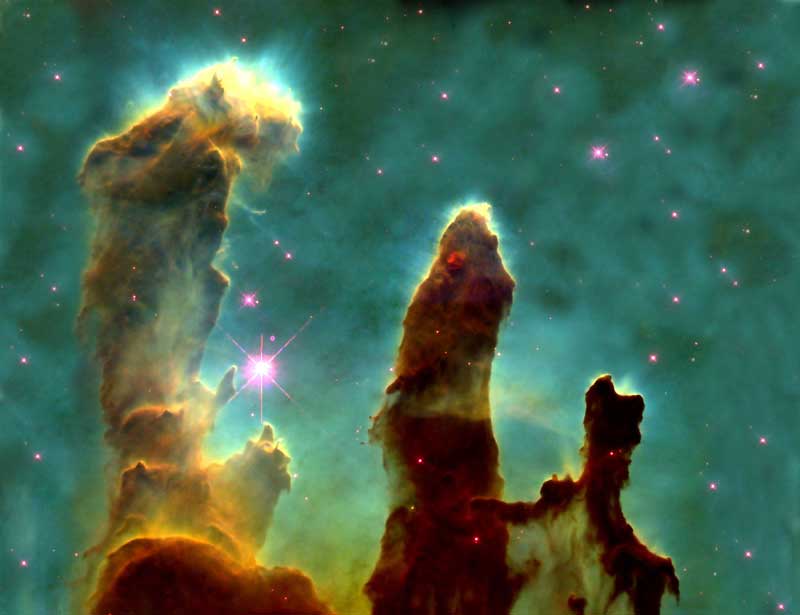
Maybe we all are inspired differently We all see something different when we look up. But the point is, as Neil deGrasse Tyson advised, Look up.
NASA

love, hosaa
looking up, where there be inspiration


Friday, November 23, 2012

Survivance and the American Indian

The little red squiggly line underneath the word "survivance" tells me that it is not an accepted English term, but it is the dominant theme of the National Museum of the American Indian, one of Smithsonian's less-traveled treasures. It's a block past the Air and Space Museum as you come from the L'Enfant Plaza Metro station. It stands between Air and Space and the Capitol dome.

All photos by C. G. Wagner; please credit and link if used.

Some takeaways, including the official museum book and a button commemorating today (Nov. 23) as Native American Heritage Day

View from the fourth floor.

Maidu Creation Story (2001) by Harry Fonseca


Background: Kiowa moccasin leggings
Inset: Kiowa Aw-Day (beaded sneakers) by Teri Greeves, 2004

The term "survivance" is attributed to Anishinaabe scholar Gerald Vizenor in the 1994 book Manifest Manners: Narratives on Postindian Survivance and means "more than survival," according to the museum exhibit notes. "Survivance means redefining ourselves. It means raising our social and political consciousness. It means holding onto ancient principles while eagerly embracing change. It means doing what is necessary to keep our cultures alive."

I admit I came to the museum today with no idea that it was Native American Heritage Day (or even American Indian Heritage Month). The day after Thanksgiving is just a good day to explore the unknown parts of my own neighborhood. And I take the broadest sense of that word: the cultures I walk among that are largely strangers to me.

So ignorant am I of this subject matter that, literally, the first I'd ever heard of Squanto was just last night, watching the Peanuts Thanksgiving special (the "Mayflower Voyages" half). So I was happy that the first exhibit I saw today had to do with Squanto, the Patuxet who was kidnapped by Europeans and, upon being returned to North America as a fluent English speaker, helped the Pilgrims adjust to the harsh land and climate.

The signage in the museum directs you to start on the upper floors, where you begin with the beginning, the mythologies of the universe and of creation. I stopped to watch a video presentation of a Cheyenne story about how the Big Dipper was formed. (Down in the bookshop, I could find no book or video or any souvenir of that charming and even tear-inducing story, but here it is at First People's Legends page: "The Quill-Work Girl and Her Seven Brothers.")

You can't help but be impressed by how fully integrated the indigenous peoples of the Americas were (and are) with their environment. It is embedded in the DNA, this reverence and respect for the natural world. I followed the crowd to a display of Alaskan wares, where there was a sheer coat made of an unusual, diaphanous material. Since I was the one standing next to the caption, I identified it for the group as "seal gut." Oooh! was the response. "They didn't waste a thing.... Waste not, want not." We all wondered how it could possibly have kept anyone warm.

"Waste not, want not" needs to apply to people. After having just seen Lincoln and the battle for treating slaves as human beings, I stood there wondering who had been treated worse--Africans who had been kidnapped from their homes and enslaved, or the indigenous peoples whose lands were stolen out from under them and killed outright. (Some of this murder was apparently an accident; the Europeans brought diseases to which natives had no immunity, and their populations were decimated.)

Death and destruction of culture continue even through "modern" times, as Native Americans have had to fight even for the right to educate children in their own languages and customs, and not be confined to a "choice" of either Protestant or Catholic schools.

I have no claims to a religious worldview, but the spiritual connection of humans to each other--and to animals, the land, the elements--makes a lot of sense to me. We are connected to everything and must be, lest we waste whatever it will take for all of our future survivance.

"Limit chaos
And cultivate order:
By singing, dancing, and
Talking to each other.
Realize life is short,
Respect your elders,
And recognize that death
Is a part of living."

--excerpt from "The Maidu Creation Story," told by Henry Azbill, 2002, and put to verse by Judy Allison